


Trigger Point Series: Levator Scapulae – Is a Tight Shoulder Muscle Causing Your Neck Pain?

Does It Hurt to Turn Your Head?
Do you ever feel a deep ache at the upper inside corner of your shoulder blade, together with stiffness along the side of your neck?
One muscle that may be involved is the levator scapulae.
The levator scapulae connects the upper cervical spine to the shoulder blade. When it becomes overworked or develops sensitive trigger points, discomfort may be felt around the side of the neck, upper shoulder, and inner border of the shoulder blade.
For some people, it can also make turning the head feel stiff or uncomfortable.
Where Is the Levator Scapulae?
The levator scapulae is a long, narrow muscle located along the back and side of the neck.
It runs from the upper cervical vertebrae down to the upper inner corner of the shoulder blade.
Its main functions include:
Elevating the shoulder blade
Helping rotate the shoulder blade
Assisting with neck side-bending
Helping rotate the neck
Because it connects the neck directly to the shoulder blade, tension in this muscle can affect both areas at the same time.
Common Symptoms of Levator Scapulae Trigger Points
Sensitive trigger points in the levator scapulae may contribute to:
✅ Pain along the side or back of the neck
✅ Aching at the upper inside corner of the shoulder blade
✅ Upper shoulder tension
✅ Neck stiffness
✅ Discomfort when turning the head
✅ Tender spots near the top of the shoulder blade
Some people describe the sensation as a deep knot that feels difficult to reach.

What Causes Levator Scapulae Tension?
The levator scapulae can become overloaded by everyday habits such as:
Looking down at a phone or tablet
Working at a computer for long periods
Holding one shoulder higher than the other
Carrying a heavy bag on one side
Sleeping with the neck in an awkward position
Prolonged driving
Repeatedly turning the head to one side
Stress-related shoulder elevation
Poor workstation setup
Repetitive shoulder activity
A common example is holding a phone between your ear and shoulder, which combines shoulder elevation with neck side-bending.
Over time, this position can place extra demand on the levator scapulae.

Simple Levator Scapulae Stretch
Step 1
Sit or stand comfortably with your shoulders relaxed.
Step 2
To stretch the right levator scapulae, gently turn your head about 30–45 degrees toward the left.
Step 3
Lower your chin slightly toward your left armpit.
You should feel a gentle stretch along the back-right side of your neck and toward the upper shoulder blade.
Step 4
Hold for approximately 20–30 seconds.
Repeat on the opposite side.
Do not force the stretch or pull aggressively on your head.

Check Your Shoulder Position
Throughout the day, take a moment to notice whether one or both shoulders are creeping upward.
Try this simple reset:
Shoulders relaxed.Neck long.Head balanced.Breathe naturally.
Small posture breaks throughout the day can help reduce prolonged muscle tension.
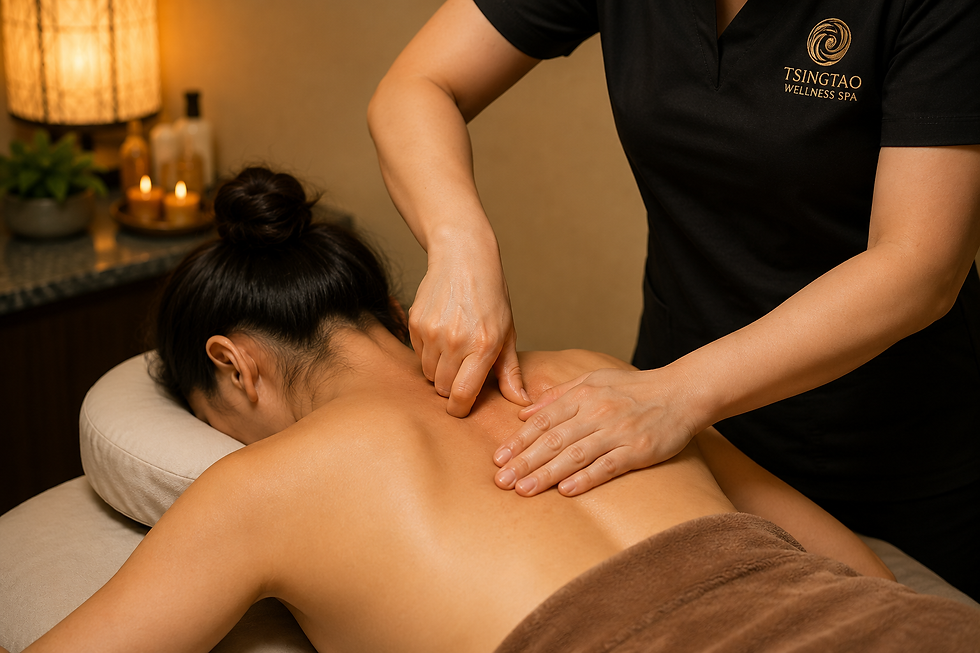
How Massage Therapy Can Help
Registered Massage Therapists commonly work with the levator scapulae when clients experience neck and upper-shoulder tension.
Depending on your needs, treatment may include:
Trigger Point Therapy
Therapeutic Massage
Gentle compression
Myofascial techniques
Swedish massage techniques
Neck and shoulder stretching
Mobility work
Because the levator scapulae lies close to several other neck and shoulder muscles, your RMT may also assess the:
Upper trapezius
Rhomboids
Posterior cervical muscles
Scalenes
SCM
Muscles around the shoulder blade
Treating the surrounding areas may be more helpful than focusing only on one tender spot.
Why Does It Hurt When Turning Your Head?
The levator scapulae assists with neck movement.
If the muscle is tense or irritated, turning or side-bending the neck may feel restricted or uncomfortable.
However, limited neck movement can have many possible causes, including joints, discs, nerves, or other muscles.
Persistent or significant restriction should be properly assessed rather than assumed to be caused by a trigger point.
When Should You Seek Professional Advice?
Neck and shoulder pain should not automatically be assumed to come from muscle tension.
Speak with an appropriate healthcare professional if you experience:
Severe or worsening pain
Pain after significant trauma
Numbness or tingling into the arm
Arm or hand weakness
Loss of coordination
Fever or unexplained illness
Significant dizziness
A sudden severe headache
Symptoms that persist or continue to worsen
Visit Tsingtao Wellness Spa
At Tsingtao Wellness Spa, our Registered Massage Therapists provide personalized treatments for neck, shoulder, and upper-back muscle tension.
Whether your levator scapulae feels tight from desk work, posture, stress, repetitive activity, or everyday muscle overuse, your RMT can assess your needs and customize the treatment to your comfort level.
Visit us at our Markham or Vaughan location and let us help you Relax. Recover. Renew.


